Ceph Foundation Founding Member
Ceph storage on the servers you already own
- 0 New servers to start Runs on hardware five to ten years old, mixed vendors
- $600 Per month for 100 TB $0.54 per raw TB plus the Basic support plan
- 200+ Customers in production Ceph at petabyte scale since 2017
Why storage projects stall in 2026
- 01
The hardware quote doubled
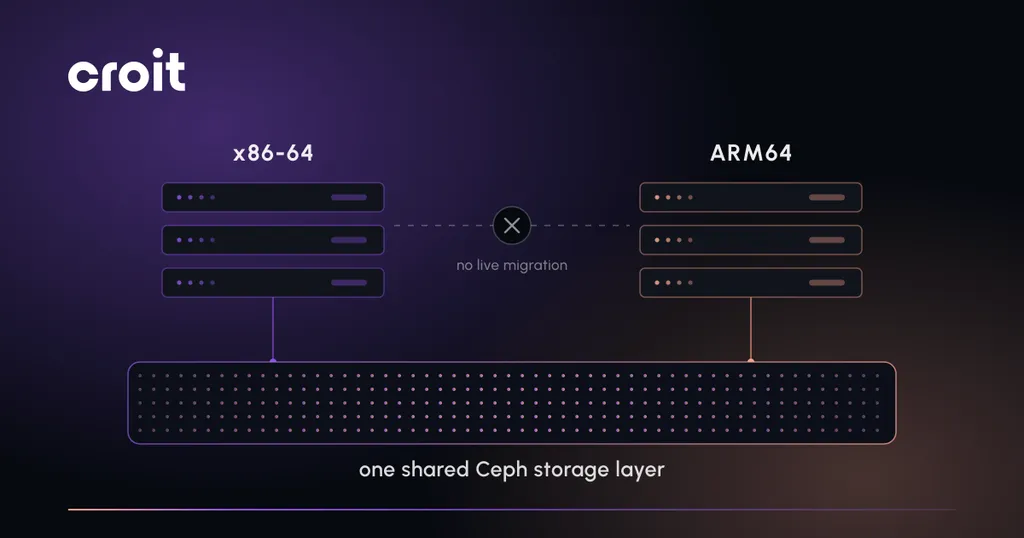
Enterprise SSD contract prices rose about 80% in the first quarter of 2026, server memory more than half again in the second, and a new server is delivered in months. Ceph was designed for the opposite: standard servers, mixed generations, mixed vendors. croit boots the servers you already own over the network and makes them one cluster. Modest upgrades, more memory or an NVMe for the database, bring an eight-year-old server up to spec.
- 02
Nobody on the team has run Ceph
That is the sentence that keeps Ceph out of most data centers, and it is the one croit was founded to answer. The croit interface does the daily work, from adding a disk to upgrading Ceph, and engineers who have run hundreds of clusters answer 24/7 and join you on a live screen share. If you want none of it, we run the cluster for you.
- 03
A security update nobody dares to run
Ceph Tentacle 20.2.4 closes four security issues and requires every key in the cluster to be renewed. On a cluster you run alone, that is a weekend and a risk. On a croit cluster, the update ships tested, the key renewal is guided in the interface, and an engineer is on the call if you want one.
- 04
The budget went to AI
Training data, model files and results need a home that is not a hyperscaler bill. Ceph serves S3, file and block from the same disks, so the storage under the GPU cluster is the cluster that also holds backups and virtual machines, on hardware written off years ago.
Price it on the capacity, not the hardware
Start from
Raw capacity
Data protection
Support plan
1-hour response, 24/7
Raw capacity
500 TBUsable capacity
267 TB
Survives 2 drive failures at once. Usable at 80% fill, Ceph's own headroom included.
croit software and support
$16,344 / €12,912 per year
- 500 TB raw at $0.54 / €0.50 per TB $270 / €250
- Premium · 1-hour response, 24/7 $1,092 / €826
Usable capacity assumes a cluster filled to 80%, the rest being Ceph's own headroom. List prices in US dollars and euros, excluding VAT. Capacity discounts apply to the per-terabyte line.
A used drive dies. Nobody wakes up.
- 03:12
Drive fails
An eight-year-old SAS drive in server 4 stops answering. Ceph marks it down; every client keeps reading and writing.
- 03:17
Recovery starts
Every object on the drive still exists elsewhere in the cluster. Ceph rebuilds the missing copies across the remaining drives, throttled so production does not notice.
- 05:40
Fully protected again
Every object is back at its target redundancy. Nothing was restored from backup, nothing was offline.
- 09:00
Replaced from the UI
The next morning, you pick the failed drive and a spare in the same server. croit reuses its place in the cluster, so nothing rebalances twice.
Times from a mid-sized cluster; recovery takes longer with larger drives and slower networks. What does not change: no client noticed.
One cluster, every protocol
S3 · Swift
S3 object storage, after MinIO
MinIO's community edition was archived in 2026. Ceph's S3 gateway has served production buckets for a decade, with versioning, Object Lock for immutable backups, and multi-site replication. Your applications keep their S3 clients.
RBD · iSCSI · NVMe-oF
Block storage for Proxmox and VMware
Leaving VMware and vSAN? Ceph is the storage Proxmox VE was built around, and croit serves it as an external cluster to Proxmox, VMware, Kubernetes and OpenStack alike, over RBD, iSCSI and NVMe-oF.
CephFS · NFS · SMB
File storage: CephFS, NFS and SMB
A POSIX file system that grows with the cluster, exported over NFS and SMB for the workloads that expect a share. Snapshots, quotas and the same disks as everything else.
Object Lock · CephFS
Backup targets and AI datasets
Immutable, versioned buckets for backup software; a shared file system for GPU nodes; capacity that grows by adding a server, not by buying an array.
Built into croit, not bolted on
croit Datacenter Manager
Every cluster you run on one map, with logs, disks and updates one click away, and S3 multisite or mirroring between sites set up from one place.
CephFS Guard
Ransomware detection on the file system itself, beside the data path: a snapshot at the first sign, and only the attacker's key locked. Included with croit.
croit NFS and SMB
NFS 4.0 to 4.2 gateways that share one session state, so a failed gateway means a short reconnect, not a hung mount, with a Ceph key per tenant. SMB from the same service, available end of 2026.
How it works
- 1
Send us your inventory
Servers, drives, network. We check them against our hardware guidance and tell you what needs a small upgrade, if anything.
- 2
Boot from the network
croit runs on one management node and boots every server over the network. Nothing is installed on the nodes; a rebuild is a reboot.
- 3
Pools and protocols
Replication or erasure coding per pool, then S3, block, CephFS, NFS and SMB from the same cluster, in the interface.
- 4
Production, with an SLA
Upgrades, security updates and the daily work run through the interface, with 24/7 engineers on call and an SLA behind them.
"We reduced our storage costs by about 30% after moving to croit. Day-to-day Ceph operations are simpler, and performance has been consistently better for our workloads."


Ready to get more out of the servers you have?
Two lines on every quote: the croit software at $ 0.54 / € 0.50 per raw TB and month, and a support plan from $ 546 / € 413 per cluster and month, up to a fully managed cluster. Send us your inventory and you get a hardware assessment and a quote within one working day.
FAQs
Yes. Ceph was designed for standard servers and assumes hardware will fail: data is kept in several copies or erasure-coded across servers, and a lost drive or server is rebuilt automatically. Servers five, eight or ten years old run production clusters, and they need not share a vendor or processor generation. croit's hardware guidance tells you what to check; often more memory, an NVMe for the database or a faster network card is all an older server needs.
Three servers are the minimum for a cluster that keeps three copies of the data. Erasure coding, which turns more of the raw capacity into usable capacity, needs a server per chunk to survive the loss of a whole server: six for 4+2, eleven for 8+3. The estimator on this page shows the usable capacity and the failure tolerance for your count.
With three replicas, a third. With erasure code 4+2, two thirds; with 8+3, about 73%. Plan to fill a cluster to about 80% so Ceph has room to rebuild after a failure. A cluster of six servers with twelve 8 TB drives each, 576 TB raw, holds about 384 TB usable with 4+2.
Two lines. The croit software is $ 0.54 per raw terabyte a month. The support plan is a monthly fee per cluster: Basic with a 4-hour response $ 546, Premium with a 1-hour response $ 1,092, Proactive with 24/7 monitoring $ 2,184. A 100 TB cluster on Basic is $ 600 a month, 1 PB is $ 1,086. From 11 PB the per-terabyte line is discounted by 10%, from 15 PB by 15%, from 20 PB by 20%. Prices in US dollars excluding VAT; customers outside the Americas are quoted in euros. The estimator on this page does the arithmetic for your cluster.
There is no license per terabyte from a storage vendor and no per-CPU fee for the storage layer of a hypervisor, and the hardware is whatever you have or can buy used. What you pay for is the croit software and the engineers behind it, per raw terabyte. Customers who moved from proprietary arrays report storage costs about 30% lower; the saving is larger when the alternative is buying new hardware in 2026.
Yes. Ceph's RADOS Gateway speaks the S3 API, so applications keep their S3 clients and credentials model, and it adds versioning, Object Lock for immutable retention, lifecycle rules and multi-site replication. croit configures the gateway, the users and the buckets in the interface. Migration is a copy between two S3 endpoints.
Ceph is the storage Proxmox VE integrates most closely with. croit runs it as a separate storage cluster, so the same cluster can serve Proxmox, a VMware environment that is still being migrated, Kubernetes and bare-metal servers at once, over RBD, iSCSI and NVMe-oF. croit is a Proxmox Gold Partner and supports both sides.
Ceph Tentacle 20.2.4 closes four security issues, among them an authentication bypass in CephX, and requires every key in the cluster to be renewed because the old ones use an insecure algorithm. croit ships the release tested, guides the key renewal in the interface, and handles the compatibility setting that keeps multi-site replication working while paired clusters are still on older versions. An engineer joins the update if you want one.
S3 and Swift object storage, RBD block storage, iSCSI and NVMe-oF for hypervisors and bare metal, CephFS as a POSIX file system, and NFS and SMB exports of it. All from the same cluster and the same disks, configured in the croit interface.
Yes, when you need it. croit sources new and refurbished servers that match our hardware guidance and delivers them ready to boot into the cluster. Most customers start on what they have and add servers as the cluster grows.
No. Ceph is open source and croit is a founding member of the Ceph Foundation. Your data lives in standard Ceph pools, readable by any Ceph client, and the cluster keeps running if you stop using croit. What you lose is the interface and the engineers, not the data.
Send us your inventory, servers, drives and network, through the form on this page. You get a hardware assessment and a quote within one working day. From there, a cluster on existing hardware is booted and serving data within days.